Saint Lucy or Saint Lucy of Syracuse; learn all about this patron saint of the blind, writers and especially miraculous for sight, throat and bleeding problems.
History of Saint Lucy of Syracuse
Saint Lucy, or Saint Lucy of Syracuse, was an extraordinary devotee of Christianity, her hagiography indicates that she lived at the end of the third century and the beginning of the fourth century of our era, some chronicles date her birth to the year 283, in the maritime city of Syracuse, Italy, she belonged to an economically solvent family, but when she was about to turn twenty, Lucia, in accordance with her love for God, took vows of chastity and poverty. At a time when Christians were being persecuted, she was accused of refusing to worship the Roman gods and was arrested and martyred in Syracuse, Italy, on 13 December 304.
The life of Saint Lucy
Saint Lucy, or Saint Lucy of Syracuse, came into contact with the growing Christian faith as a child, thanks to the interest shown by her mother, called Eutychia. Lucia owes her name to her father, Lucius, who died when she was a child. This name also means the enlightened, the luminous or the bearer of light, which coincided with her actions in life. Saint Lucy has left us a clear example of how the Word of God and the teachings of Jesus Christ can influence the minds of young people, giving them the strength to act for the good of their fellow human beings, despite the martyrdom to which they may be exposed, fulfilling in many ways the heavenly mandate to become saints or to seek holiness through a life dedicated to divine service.
Saint Lucy, Virgin and Martyr
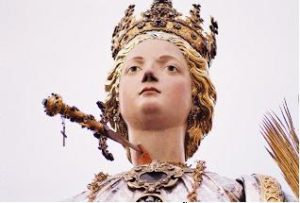
Saint Lucia or Saint Lucy of Syracuse, by virtue of her vow of chastity, refused the promise imposed on her by her family to marry a young man from a distinguished family who was a fanatical follower of the Roman gods of that imperial era; her fiancé, as a form of revenge, denounced her for practising Christianity to the governor Pascasio, for which she was arrested and forced to renounce her Christian faith, Saint Lucy or Saint Lucy of Syracuse refused such impositions, then they imposed her punishment of being taken to a place of prostitution, but in vain, several guards tried to remove her from her place of confinement, then they tried to burn her, but in vain, as the flames moved away from her, because of such miracles that saved her from being outraged and burned alive, she was accused of sorcery and they chose to complete her martyrdom by slitting her throat.
The origin of the legend of Saint Lucia
Ancient engraving of Saint Lucy
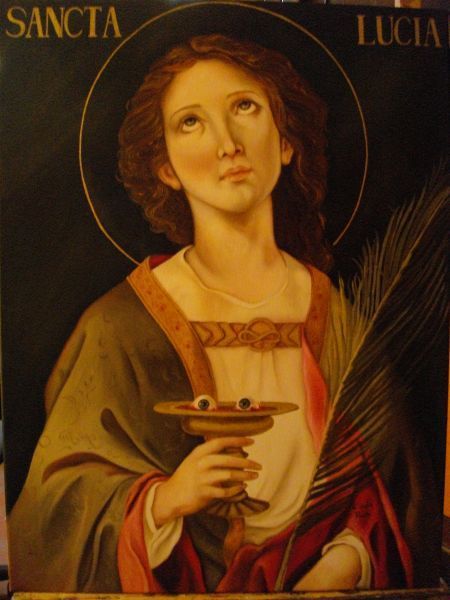
The authors on the life and work of Saint Lucy or Saint Lucy of Syracuse are not credible, many ancient martyrologies do not agree in their data, so the oral tradition prevails, in which there are clear signs of exaggerated praise and a sense more poetic than historical, this situation has promoted Saint Lucy of Syracuse more as a legend than a real figure, although after the expansion of her devotion the miracles attributed to her are unobjectionable.
Legend of Saint Lucy of Syracuse
Saint Lucy, or Saint Lucy of Syracuse, followed a path marked by her love for God. According to many ancient versions, her legend began to take shape when she suffered martyrdom and had her eyes gouged out for declaring that she had seen Jesus Christ being praised in heaven by the angels; confined to a dungeon to be executed the next day, Saint Lucy or Saint Lucy of Syracuse was visited in her cell by the Virgin Mary, who consoled her in her suffering, healed her wounds, restored her sight and gave her beautiful eyes. Years later, Pope Gregory the Great (590-604) dedicated liturgical acts to her, popularising her legend.
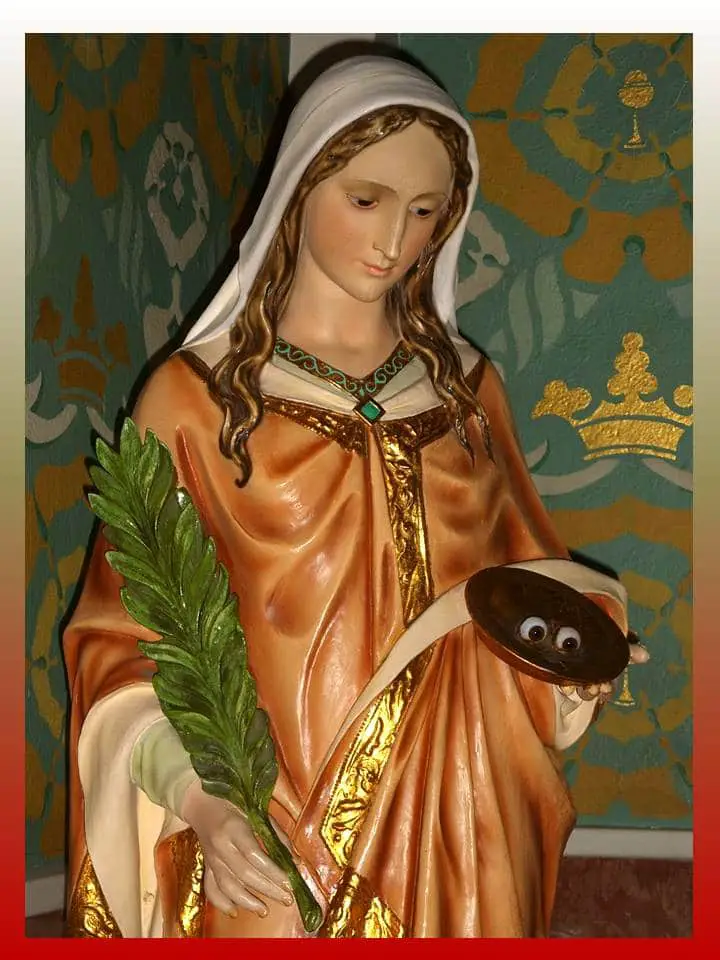
St Lucia
Saint Lucy and religion
In 303 Lucia and her mother received the sacrament of baptism, and although at that time devotion to God was condemned in the Roman Empire, Saint Lucia, or Lucy of Syracuse, took her vows of virginity and poverty, gave her goods to the humblest peasants and preached the Gospel. Her faith was confirmed when she prayed to Saint Agatha, the patron saint of the city of Catania, Italy, for her mother’s health and she told her in a vision that her ancestor had been healed by consecrating her body and soul to the service of God, and even more by her faith, and she also prophesied that she would be Saint Lucy, a saint who would bring glory to the city of Syracuse, a prophecy that has been fulfilled over the centuries throughout the world.
Stories that make Saint Lucia a legend
The stories that give the biographies of Saint Lucia or Saint Lucia of Syracuse their legendary quality relate to events that took place during her martyrdom, the most important of which is that she tore out her own eyes to send them to her traitorous fiancé, Others say that it was the governor Pascasio who plucked out her eyes so that she would no longer look at the images of Jesus Christ, that she was able to speak even when her throat was pierced by a sword, and that she declared herself the patron saint of Syracuse.
Other assumptions that make Saint Lucy a legend
There are stories that Saint Lucia or Saint Lucy of Syracuse was tied with ropes to several oxen and they could not move her, in other stories it is not animals but Roman guards who could not move her either, one of these oral traditions tells that one of her jailers tried to rape her but the saint’s hair began to grow rapidly and covered her from her face to her feet, preventing the guard from his cruel act. All these legends are justified by her followers on the grounds that she was protected by the divine power of God, but what her many devotees attest to is her ability to perform miracles.
The miracles of Saint Lucy or Saint Lucy of Syracuse
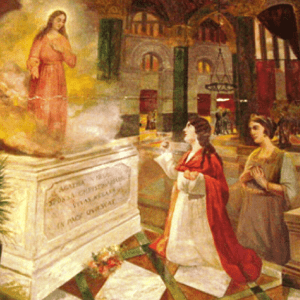
The miracles of Saint Lucy begin when Saint Agatha appears to her in a vision and tells her that her mother has been healed by her own merit, which is her unwavering faith in the one God.
Another prodigy attributed to Saint Lucy, or Saint Lucy of Syracuse, was that of prophesying the downfall of the then Roman Emperor Diocletian Augustus, who ruled between 284 and 305, and the subsequent cessation of persecution of Christians; she also miraculously saved her native Syracuse from famine in 1646.
When prayed to with faith, she can heal sore throats, stop bleeding, strengthen Christian faith, provide food, and the most important miracles attributed to Saint Lucy or Saint Lucy of Syracuse have to do with the healing power of sight.
The patronage of Saint Lucia or Saint Lucy of Syracuse
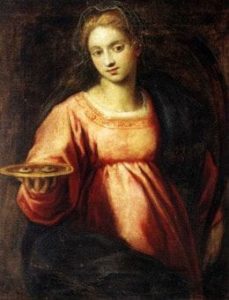
Saint Lucia or Saint Lucy of Syracuse, due to the various characteristics she manifested in her life, is considered the patron saint of writers, the poor, seamstresses, dressmakers, tailors, photographers, she is also the patron saint of the Italian cities of Syracuse and Venice, as well as of Zacatecoluca in the Republic of Salvador, Santalla de Rei in Spain, Mossoró in Brazil, among others, and she is most recognised as the patron saint of the blind or visually impaired.
Saint Lucy, patron saint of the blind
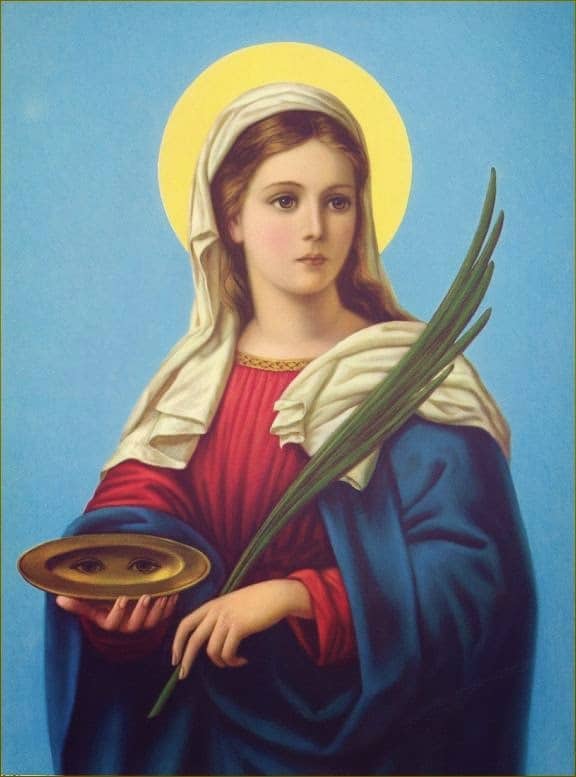
Saint Lucia, or Saint Lucy of Syracuse, is traditionally known as the patron saint of the blind, of ophthalmologists, of everything related to the sense of sight, and is prayed to for protection against blindness, because her name, in its Latin root, means light, or that she was born with the light of dawn, also because of the miracle granted to her by the Virgin Mary of healing her eyes. It is a tradition that in ancient paintings or iconographies she is represented as cured of her sight, holding a pair of eye sockets on a plate.
Prayer to Saint Lucy or Saint Lucy of Syracuse
It is customary that a prayer to Saint Lucia or Saint Lucy of Syracuse, in the sense of praying to her as a consecrated saint so that she may grant us the grace to restore our health broken by problems of sight, throat, haemorrhoids, or to strengthen our Catholic faith, should include in this supplication phrases that glorify her holy name, as well as highlighting the acts of faith, sacrifice, and defence of Christianity that this saint carried out throughout her life and especially during her agonising martyrdom. Since ancient times, and still today, many of her devotees claim that praying to Saint Lucia is particularly effective in curing visual disorders.
Saint Lucy’s Day or Saint Lucy of Syracuse’s Day
Since about the 4th century, 13 December has been the traditional date for the feast of Saint Lucy or Saint Lucy of Syracuse. This was confirmed in 1844 when, in a cemetery in Syracuse, an inscription in Greek was discovered on one of the tombs, stating that the deceased had died on the feast of Saint Lucy and briefly describing her as a faithful and perfect Christian. The feast of Saint Lucy was a local celebration that quickly spread to Rome, where a monastery was dedicated to her in the 6th century. The first papal document to mention her feast is the Sacramentary of Pope Gregory the Great.
Feasts in honour of Saint Lucy of Syracuse
Every year on the 13th of December, it is customary to celebrate the feast in honour of Saint Lucy or Saint Lucy of Syracuse in various countries in Europe and America, Italy, Sweden, Spain, Colombia, the Dominican Republic and Venezuela being some of them. In Venezuela, these celebrations are held in the states of Miranda, Merida, Yaracuy, Aragua and Zulia. In Maracaibo they begin on 20 November to the sound of the gaitas (bagpipes), with a procession and a novena.
The majestic festivities of Syracuse
The city of Syracuse pays tribute to its patron saint, Saint Lucia or Saint Lucia of Syracuse, which begins on the 13th of December and ends on the 20th of the same month. The celebrations consist of a procession through the city with songs and prayers, the consecration of children to Saint Lucia, the dressing of girls with the name of Lucia in red to symbolise her martyrdom and of others in white to symbolise her purity, and a spectacular fireworks display. For the people of Syracuse and the pilgrims, these festivities represent the eternal triumph of good over evil, because for many, Saint Lucy is a very living presence.
Reason for the Grain Festival in Syracuse
These festivities are held to commemorate the great famine that struck Syracuse in 1646 and brought a large part of the population to the brink of death, for which public prayers were held from the 6th to the 13th of May that year, asking Saint Lucia or Saint Lucy of Syracuse to save the city; On the 13th of May 1646, a white dove was seen on an altar and at that moment a voice was heard in the church announcing the arrival of a ship loaded with grain in the harbour, which would save the city from starvation. It was later recognised as a miracle of Saint Lucia that the ship was diverted to the ports of Syracuse in those dreaded hours.
Syracuse and its grain festivals
Since 1646, in the month of May, the feast of Saint Lucia of the Grain is celebrated in Syracuse. During these festivities, countless doves are released to symbolise the mysterious dove that landed on the altar of the Basilica at the very moment when the ship full of grain arrived in the port; a silver statue in the square of the Basilica represents the Syracusans almost dying, They also make a cart full of grain pass in front of the platform of Santa Lucia or Santa Lucia of Syracuse, as a reminder of those grains that saved them in that fateful year of 1646, thanks to the miraculous action of Santa Lucia, worthy patron saint of Syracuse.
Saint Lucia or Saint Lucy of Syracuse Santor
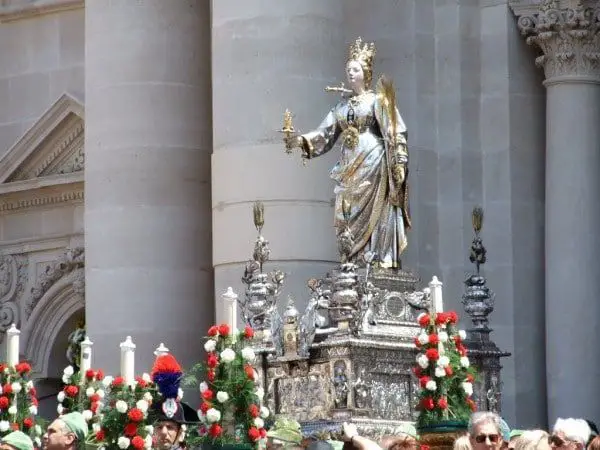
The saint’s day of Saint Lucy, or Saint Lucy of Syracuse, is celebrated every year on the 13th of December, as a reminder of her death, since it is the same date, but in the year 304, when Saint Lucy ended her earthly life through the torture of martyrdom. In almost all writings, this date, 13 December, is the most accurate date to place in time the events that ended her life, although in the past some martyrology lists placed it on 12 December and others on 5 February, together with the day of Saint Agatha, but it is now fully accepted to consecrate every 13 December as the day of Saint Lucy.
Novena to Saint Lucy or Saint Lucy of Syracuse
Reproach to God
Most Merciful Eternal Father, eternal fountain from which flow endless streams of mercy with which the barren earth of human hearts is watered, (…).
To Saint Lucy
O pious virgin and martyr Saint Lucy, whose most innocent life was a whole host, offered in holocaust to the true God, given in cruel martyrdom to the universal God, suffering the most terrible tortures, ending her earthly existence with a vile sword, I hope that You will grant me the grace I ask in this novena, if it is for the greater glory of God, Your honour, my spiritual well-being. Amen.
Conditions for this novena to Saint Lucia
It is appropriate to begin the novena on the 5th of the month and to end it on the 13th, if it is in December it is more appropriate because it is the day of her holy devotion. The way to pray this novena is to kneel before her image, make the act of contrition, pray the preliminary prayers dedicated to God and to this saint that begin the novena, 03 Our Fathers and 03 Hail Marys, then the two corresponding prayers of the day, make the supplication, end with a prayer to Jesus Christ and do not forget to make the act of contrition on all or some of the days of the novena.
https://www.youtube.com/watch?v=2c5GCigktf8
The remains of Saint Lucy or Saint Lucy of Syracuse
Since her death, the body of Saint Lucy, or Saint Lucy of Syracuse, was placed in a tomb by her mother Eutichia, and remained guarded by her Christian countrymen in her home town of Syracuse, where a church called the Basilica of Saint Lucy of the Sepulchre was built in 320. When Syracuse was taken by the Saracens in the 9th century, her remains were hidden to prevent their desecration. Later, in 1040, a Greek general took the relics to Constantinople and gave them to Queen Theodora.
The relics of Saint Lucy from Venice to Syracuse
During the Crusade of 1204, the Venetians conquered Constantinople, recovered the body and placed it in the church dedicated to St Jeremiah, now known as the Basilica of Syracuse.
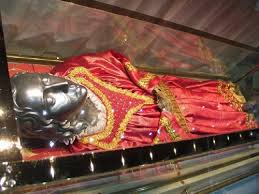
Today known as the Basilica of Saints Jeremiah and Lucy, where it remained until 2004. The inhabitants of Syracuse were filled with joy in 2004 when the remains of their patron saint were returned after an absence of 905 years, received by thousands of faithful and placed in the Basilica of Saint Lucia of the Sepulchre. The head of Saint Lucy, or Saint Lucy of Syracuse, remains in the image of the Basilica of Syracuse, so the newly arrived body was fitted with a silver-plated metal head to be fully appreciated.
Iconography of Saint Lucy or Saint Lucia of Syracuse

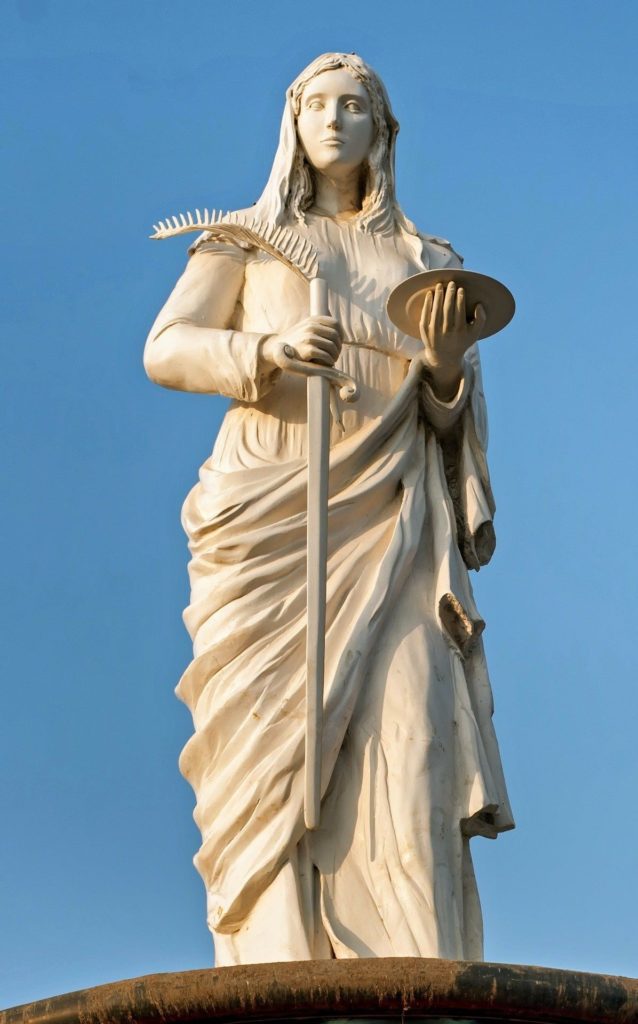
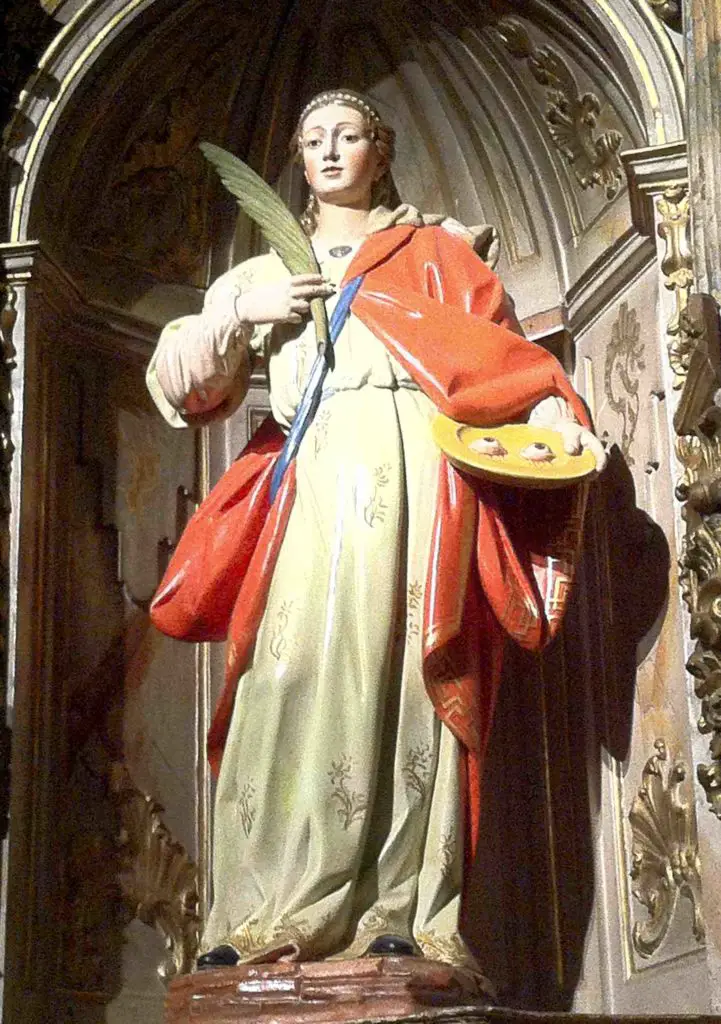
The most common image of Saint Lucy or Saint Lucia of Syracuse is to see her holding a flat dish or a cup with two eye sockets, with her beautiful face showing healthy and spectacular eyes, miraculously given to her by our common Mother, the Virgin Mary; other times we see her with her throat pierced by a dagger, in other figures she holds a lamp or a book, or has flames on her feet, and generally she is dressed in Roman style, there are paintings and sculptures that show her in the different stages of her short life, even her martyrdom and death.
The merits of Saint Lucia’s veneration

When Saint Lucia, or Saint Lucy of Syracuse, took her vow of poverty and distributed her wealth among the poorest peasants, preaching the holy word as far as the censorship of the Empire allowed Christians at the time, she began to cement her fame as a fervent Christian, as she was known to have come from a family of landowners. It was during the torture of martyrdom that the Syracusans became aware of the virtues of this saint, first through the eloquence with which she answered the questions of her interrogators, and then through the miracles by which God saved her life.
The growth of devotion to Saint Lucy of Syracuse
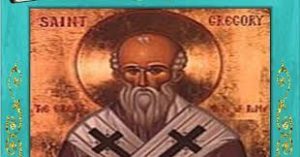
Because of the wisdom she showed before the Roman governor Pascasius, and the vain attempts to make her deny God by torturing her, Saint Lucy, or Saint Lucy of Syracuse, became an example of sincerity and spiritual strength that inspired many of her fellow citizens to follow her faith, who were eyewitnesses to the last hours of her life, defending her faith firmly despite the fact that she was subjected to one of the worst martyrdoms ever suffered by a Christian. When she died as a martyr, she was buried in a catacomb in Syracuse, which soon became a place of pilgrimage for the Sicilians.
The devotion to Saint Lucy of Syracuse is growing
One of the first Italian cities, apart from Syracuse, to know the cult of Saint Lucy, or Saint Lucy of Syracuse, was the city of Ravenna, in the year 384, then her devotees came from neighbouring Venice, then Milan, Naples, and so, year after year, her fame spread throughout a large part of Europe. One of the most important promoters of the veneration of Saint Lucy was Pope Gregory the Great (540-604), who included her name in the Holy Mass, and in time she and the city of her birth, Syracuse, became famous. Today she is venerated in many countries, especially in Latin America.
Saint Lucy and her resemblance to other saints
Some saints have similarities with Saint Lucy or Saint Lucy of Syracuse, either because the same miraculous powers are attributed to them or because they have similar physical characteristics, as in the case of Saint Ottilia and Saint Catherine of Alexandria.
Saint Lucy and Saint Ottilienne
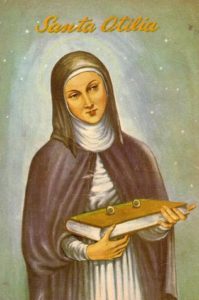
St Otilia
Saint Lucia, or Saint Lucy of Syracuse, and Saint Ottilia (662-720) are saints known for having been asked by the faithful to heal their eyesight, this because Saint Odilia, although born blind, God granted her the miracle of recovering her sight during her baptism, In their iconographies they are both represented holding a pair of eye sockets, they differ in that Saint Lucy holds them on a plate and Saint Ottilienne on a book, also because one is French and the other Italian.
St Lucy and St Catherine of Alexandria.
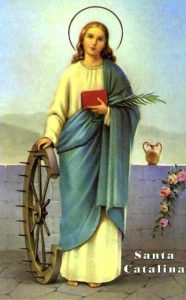
Saint Catherine of Alexandria has the following analogies with Saint Lucy or Saint Lucy of Syracuse: Saint Catherine of Alexandria was a Christian martyr who, like Saint Lucy, refused to worship the Roman gods. She was so eloquent that she persuaded several wise men to convert to Christianity, in accordance with her vow of virginity, she had pledged her soul and body to the service of Jesus Christ from a very young age, she expressed her refusal to be given in marriage, she was beheaded when she could not be killed with a terrible device used to martyr Christians, she is represented with a book because she was the patron saint of students and philosophers.
Churches dedicated to Saint Lucy or Saint Lucy of Syracuse

In the place where she was imprisoned on the eve of her martyrdom, the Cathedral of Santa Lucia de la Cárcel was built, and in the place where she died, the Church of Santa Lucia de la Tumba. There are also churches dedicated to her in most of the countries where she is venerated. In Venezuela, in the city of Maracaibo, the neo-Gothic church of Santa Lucia, built in the 19th century, is dedicated to her.
Venezuela and Santa Lucia of Syracuse
In Venezuela, the devotion to Santa Lucia or Santa Lucia of Syracuse dates back to the time of the conquest, mainly by the Spanish and Italian immigrants, and writings from the 17th century have been found which refer to the existence of an altar dedicated to Santa Lucia in the city of Maracaibo, in the state of Zulia. Today, it is a tradition to celebrate the saint’s feast day on 13 December, both in the capital of Zulia and in many other places in Venezuela. Another proof of the Venezuelans’ devotion to the Italian martyr are the various towns that bear her name.
Saint Lucia Shining Light of the World
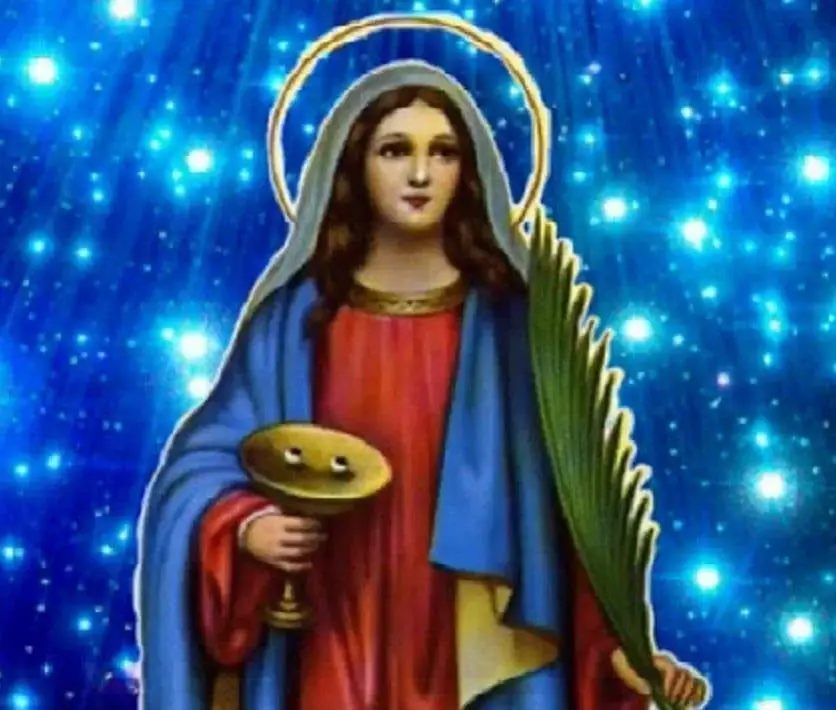
Saint Lucy of Syracuse is a clear example that strengthens us in our Christian faith, her devotion to God in times of religious intolerance moves us to avoid those elements that are instruments of evil to infect us with spiritual blindness, such as drugs, a scourge that corrupts our young people, the high sense of solidarity with which she acted reminds us that it is better to have heavenly treasures than to hoard material goods, by her exemplary life Saint Lucy of Syracuse was and will continue to be a powerful light that illuminates the world. Lucy of Syracuse was and will continue to be a powerful light that illuminates the world and is the hope that each new day can have a radiant dawn.
There is no sin without consent to evil.