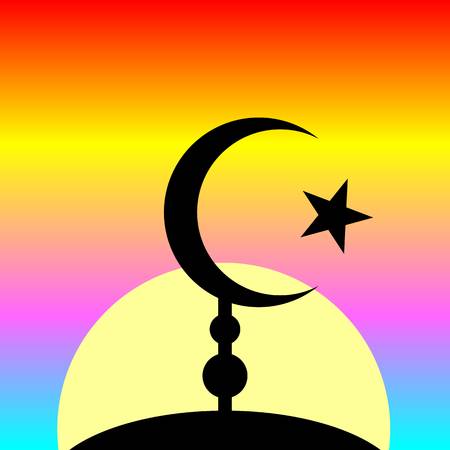
Islam began with the preaching of Muhammad in Mecca in 622 and it is estimated that there are just over 1.2 billion Muslims in the world. There is no official basis for establishing that the star and crescent is the symbol of Islam, but most believe it to be.
Islamic symbols and their meaning
Signs or symbols have been used by humans since the beginning of history, long before written language. They are used to externalise and represent a thought or idea, taking into account the similarity, real or imagined, with its meaning, and for many they form an icon that reinforces faith and inner strength.
Muslims do not use the symbols of their religion in the same way as Christians, who worship them and sometimes place their faith or mystical belief in them. However, they do have some that identify their culture and religious beliefs.
For many, the colour green is the colour of Islam, but scholars have said that this is not true. The same goes for the star and crescent, which do not symbolise Islam, which many worship as such. Worshipping the symbols of Islam is criticised as being against monotheism.
Star and crescent
The star and crescent was simply a symbol of the Ottoman Empire, not of Islam. This symbol consists of a crescent moon with a star, which is not actually a star but represents the planet Venus (see article: Features of Islam).
In the modern version, this star has five points which, together with the moon or crescent, are considered by believers to be symbols of Islam. For Muslims, they symbolise sovereignty, openness, nobility, concentration, victory and divinity.
The crescent moon represents long life, dexterity and skill. The waning moon, on the other hand, heralds the arrival of something sinister. It is a divine cyclical sign that regulates time, change and transformation.
At least one-fifth of the world’s population adheres to the Islamic faith, whose teachings are based on the revelations of Muhammad, a prophet who lived in Arabia, and whose rules and principles were compiled in a book sacred to Muslims or Islam, the Qur’an.
Muslims, like Jews and Christians, worship one God, known to them as Allah, and profess their faith as an act of submission to His will. Among their most fundamental beliefs are the Five Pillars, which require believers to 1) publicly profess their faith; 2) pray five times a day; 3) give alms; 4) practice abstinence during the month of Ramadan; and 5) make a pilgrimage to Mecca (see article: God of Islam).
When did the crescent become the symbol of Islam?
Worshipping the moon is an ancient practice in the Arabian Peninsula, the most popular symbol being the crescent; there was a time when the moon was so important that it represented the entire country, something that can still be seen on Islamic flags.
Even the Qur’an itself uses lunar symbolism. The Qamar, or moon in English, is frequently mentioned in the Qur’an, as is the sun, one of the most powerful signs of Allah, to which the moon pays homage. Through the phases of the moon, Allah has subdued mankind, controlled their time and calculated the days.
It is believed that the moon will divide, unite with the sun and be eclipsed on the day of reckoning. There are two calendars, a solar calendar, used for agricultural purposes, and a lunar calendar, used for religious purposes, as the moon regulates canonical acts.
They also believe that the phases of the moon and the crescent evoke death and resurrection, but it is also an image of absolute beauty. When people want to describe something that is overly beautiful and perfect, they describe it in terms of the moon. The moon is seen as the guide of the nights, when farmers and caravanners want to rest and walk under its light, the night becomes nourishing and sweet.

Hilal, its meaning
Muslims attach great importance to the moon, its appearances and its setting in houses, in order to construct their calendar. The Muslim calendar is lunar, the months beginning with the appearance of the crescent moon. They have another, also lunar, to mark religious festivals and another solar calendar to guide them for agricultural purposes.
It is also present in the letters of the alphabet, which they classify as solar and lunar. The strength of the moon determines when religious practices should be performed, and the appearance of the hilal, or crescent moon, marks the beginning of a new month in their calendar. The first lunar day is marked by the Islamic pilgrimage to Mecca.
The moon has three stages, one being its birth, its first rise as a small crescent and so on until it takes its final circular shape and reaches its final stage.
In Arabic the crescent is called Hilal, Badr when it is in the shape of a semicircle and Qamar when it is fully circular.
Versions of its adoption as a symbol
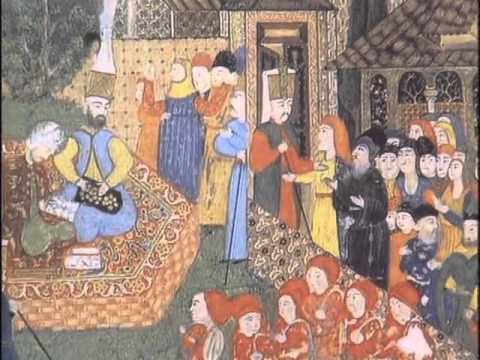
The crescent was adopted as a symbol of Islam in the 14th century. Initially its image represented a crescent moon and was associated with the goddess Diana, later the star was added as a symbol of sovereignty and divinity. It was a symbol of Turkish identity, but was later adopted by many Arab countries on their flags.
Its origins go back to pre-Islamic tradition, although it really came to prominence in the 12th and 13th centuries with the establishment of the Ottoman Empire in Asia Minor, whose flag featured the crescent, which is still reflected in the flag of modern Turkey.
According to the “Sourcebook of Medieval Warfare: Christian Europe and its Neighbours” (David Nicolle), the crescent comes from the pre-Islamic Sassanid tradition. Some authors have seen in it the hoofprint of a horse, alluding to the Islamic horsemen who conquered the world for Islam. It remained a non-Islamic symbol for a long time, until it became very popular in the Turkish-Muslim world in the 12th and 13th centuries.
Muhammad used a standard they called “the eagle”, a late Roman-style eagle mounted on a spear. The Abbasids originally used javelins or short spears as standards, a Roman-style tradition probably introduced by Arabs from the Syrian frontier. The crescent appears on a tribal flag of the Nakha (7th century).
This crescent coexisted for a long time with other symbols, some of them very popular, such as the “Hand of Fatima”, “standardised” Koranic inscriptions, animals and beasts: lions, eagles, dogs, dragons,… as well as various symbols used by the Mamluk elite during the 13th-16th centuries.
Over time, the crescent became consolidated as the Muslim symbol par excellence, although there is no official record of this.
The five pillars of Islam
Every Muslim must adhere to these five fundamental pillars of the Islamic religion:
The profession of faith (Shahada)
Prayer (Salat)
Charity (Zakat)
Fasting (Swan)
Pilgrimage to Mecca (Hajj)
The colours
The colour green is often associated with Islam out of habit; it has no religious significance. However, Muslims generally use calligraphic azoras to decorate mosques and their own homes.
Pan-Arabism has traditionally used red, white, green and black on the flags of Muslim-majority countries, which is why some people mistake these colours for symbols of Islam.
Countries that use these colours on their flags include Yemen, Egypt, Sudan, Iraq, Syria, Western Sahara and Palestine. Red symbolises the blood of the martyrs and the Hashemid dynasty; white was used by the Umayyads and green by the Fatimid Caliphate. Black was used by the Abbasid Caliphate. The common symbol used in wars was the crescent moon.
The Hand of God
Known as the hand of Fatima, the daughter of Muhammad. This hand represents the five pillars of Islam.
The Night Journey
Saint Gabriel, or the Archangel Gabriel, appeared to Muhammad in one of his dreams and took him to heaven. He was mounted on a steed with a human head, the Al Rorak, and his face was covered with a veil.
Muslim prayer
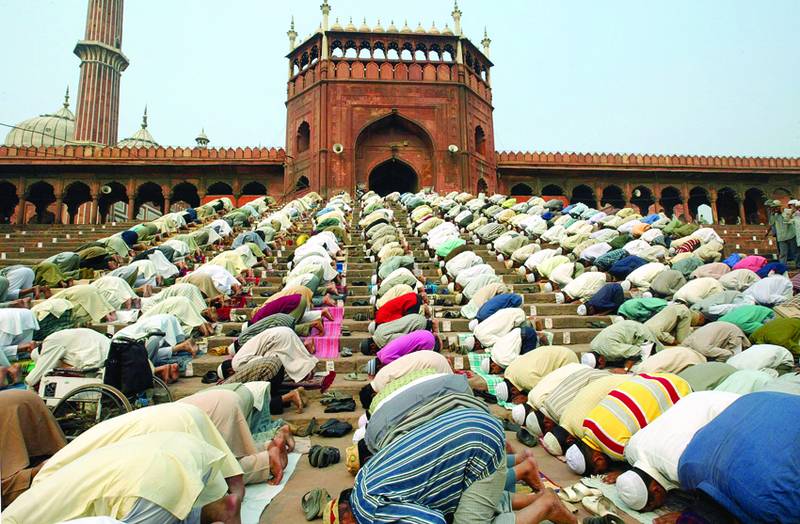
Adult men must pray side by side in the mosque. They kneel and bow towards Mecca, touching the ground with their foreheads and repeating the words “Allah is great”. This rite symbolises their spiritual submission to God.
The Kaaba
The Kaaba, located in Mecca, is the holiest shrine in Islam and is where Muslims go when they kneel to pray to Allah, wherever they are. It is a point of communication between God and man. Muslims are required to visit the Kaaba at least once in their lives and to circumambulate it seven times, with each circumambulation representing an offering to God.
Prayer mat
The Muslim must perform Salal, or prayers, by kneeling on a carpet.
Compass
Muslims usually carry a compass, or qiblah, to help them know which direction Mecca is in and where to pray to honour Allah. Modern prayer rugs used for prayer already have a built-in compass with the image of the Ka’ba in the centre.
Lamps
The mosque is illuminated by lamps inside the mosque. This light indicates the presence of divinity within the temple and represents wisdom and truth, as well as illuminating the darkness of ignorance.
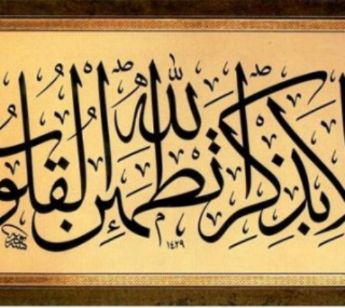
Calligraphy
A large number of objects are artistically decorated with inscriptions of Qur’anic verses, so that they are always associated with the constant and symbolic reminder of the Word of God.
Ceramic tiles
Just as the star symbolises divinity and supremacy in Islam, the decoration of Muslim homes with ornamental tiles is characteristic of the faithful believers of Islam.
Prayer beads
The Islamic rosary consists of 99 beads, each representing the same number of divine names. The hundredth, the name of the essence, can only be found in paradise.
Minaret
The minaret is always next to the mosque and from its heights the muezzin calls the faithful to prayer five times a day. Muslims believe that one day the Angel of the Resurrection will come and warn them to say the first prayer (see article: What religion are the Jews?).
The Dome of the Rock
The Dome of the Rock was built on the site of Solomon’s Temple in Jerusalem. It is a holy site for Jews, Christians and Muslims. Muslims commemorate the moment when the Archangel Gabriel received Muhammad and entrusted him with his ascension to heaven.
The great arch in the dome of the temple represents the firmament, and it is said that to pass through the arched passages around it is to symbolically pass into another plane of existence.
Islamic calendar
The Islamic calendar begins with the Hegira, the year of Muhammad’s migration from Mecca to Medina. This year would be 622 in the Gregorian calendar.
This lunisolar calendar may have 354 or 355 days, so it is not enough to subtract the 622 years from the Gregorian calendar. Similarly, Islamic holidays are celebrated on different dates each year if one follows the rhythm or sequence of the Gregorian calendar.
Art
In some Islamic countries, the depiction of living creatures in art is rejected as a challenge to Allah’s perfection. Because of this prohibition, the word itself has been immortalised artistically in the texts of the Qur’an. The Qur’an contains calligraphy of extraordinary beauty, which is considered one of the greatest Islamic contributions to art. Mostly written in Arabic, the original language of Islam, their texts illustrate the authority and truth of God’s word.
Koran
Islamic scholars believe that the Qur’an is an uncorrupted, divine text, while secular scholars see it as a normal, human text, similar to any other text. These differences make it necessary to know both versions of history.
The Qur’an, which proclaims its divine origin, challenges readers to find a contradiction in it, confident that they will not find one, for there should be no divergence in its text, precisely because of its divine character, without flaws or mistakes.
It is the holy book of Islam, also known as the Alcoran, Quran or Koran, and according to Muslims it contains the word of God revealed to Muhammad by the archangel Gabriel. During the Prophet Muhammad’s lifetime, these revelations were passed on orally or written on palm fronds, pieces of leather, bones or any other suitable material.
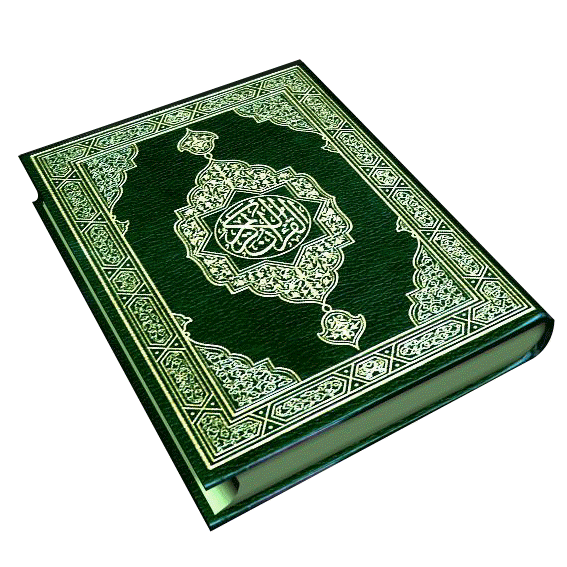
When the Prophet died in 632, these revelations were compiled by his followers, who, during the caliphate of Utman ibn Affan, turned them into what is known today as the Qur’an, with 114 chapters, each divided into verses (see article: How many books are there in the Jewish Bible).
This holy book mentions many figures that also appear in the Tanakh and the Bible, the holy books of Judaism and Christianity respectively, as well as in devotional literature such as the Apocryphal Books, with many differences in detail.
Original language
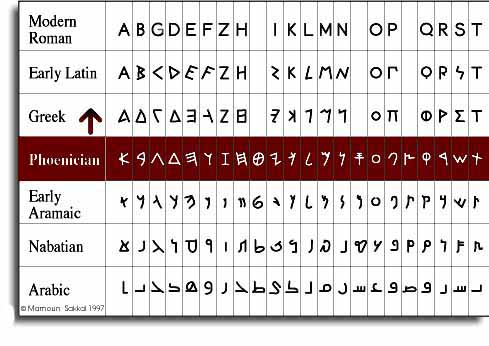
Muslims or Islamists believe that the Qur’an is the “eternal and uncreated” word of God. For this reason, they believe that it should be transmitted as it was originally written, unchanged, in its original language, classical Arabic. This holy book has been translated into many languages, especially for believers who do not know Arabic.
However, only the Arabic language is used in the liturgy, because the translation is used only for didactic value, i.e. as a tool to understand the original text. Even a translated Qur’an is not considered authentic, but an interpretation of the original.
According to Islamic scholars
Muhammad could neither read nor write; he simply narrated what was revealed to him, and his companions memorised and wrote it down.
But for some experts in textual interpretation, this tradition is not consistent with the text of the Qur’an itself, for two important reasons: 1) The Qur’an states in its text that the Prophet “did not use to read or write”, which is not the same as not knowing how to do so, implying that he was not given to reading or writing; 2) The Qur’an states in Aleya No. 2 of the Azorah “The Congregation” that the Prophet “did not use to read or write”, which is not the same as not knowing how to read or write; 3) The Qur’an states in Aleya No. 2 of the Azorah “The Congregation” that the Prophet “did not use to read or write”, which is not the same as not knowing how to read or write. 2 of the Azorah “The Congregation” reads: “It was God Who raised from among the unlettered an apostle from among themselves, who recited His Signs, purified them and taught them the Book and wisdom…”.
Followers of Islam claim that the wording of the Qur’an is literally and exactly the words of God given to Muhammad through the intercession of the archangel Gabriel.
According to non-Muslim or secular scholars
Some scholars are sceptical about the Islamic traditions concerning the Qur’an and its origins. They say that Muhammad was the author of the verses and laws contained in the text and that he attributed them to Allah to give them legitimacy.
They also claim that Muhammad’s followers memorised and wrote down his revelations, and that many versions of these revelations circulated after his death in 632. They also point out that many features of the Qur’an show signs of a human process of compilation, far removed from supposedly divine methods.
Similarities between the Qur’an, the Tanakh and the Bible
There are many stories in the Qur’an about people who are also mentioned in the Tanakh and the Bible, the holy books of the Jews and Christians respectively, as well as in devotional literature, apocryphal books and the Midrash, although with marked differences in many aspects (see article: What was the sin of Adam and Eve).
Biblical figures such as Adam, Abraham, Isaac, Noah, Jacob, Moses, John the Baptist and Jesus are mentioned as prophets of Islam. Mary is also mentioned, with the Arabic name Maryam, the mother of Jesus.
It recounts episodes about the creation of man, who would become Adam in the garden; the disobedience of the angel Iblis to prostrate himself before Adam, whose command was given by God Alláh, who then called him demon or Shaytan; it indirectly mentions Cain and Abel; Noah and the ark or ship, as well as the flood that destroyed Noah’s people, among others no less outstanding.
Comparing these texts with the New Testament of the Bible, there is a coincidence with the birth of Mary, daughter of Imran’s wife and sister of Aaron; the announcement to Zechariah of the birth of his son John the Baptist; the announcement to Mary of the birth of Jesus and her pregnancy through the work and grace of the Holy Spirit; the announcement of the coming of Ahmad, Mohammed or Muhammad, who, according to the Islamic book, will be the “Seal of the Prophets”.
Holy places of Islam
The Islamic religion has sites or places that are considered holy for the practice and profession of its faith. The most important holy places in Islam are Mecca, Medina and Al-Aqsa in Jerusalem. Let us look at the details of these mythical and divine sites.
Mecca
Mecca is a city in modern Saudi Arabia to which Muslims make a pilgrimage at least once in their lives. It is referred to in the Bible as “Padan-aram”. It is the birthplace of the Prophet Muhammad, the most important holy city in Islam, and is visited by millions of pilgrims every year.
Long before Muhammad preached Islam, the city was a holy place for pagans and contains several important religious sites, including the Kaaba.
The Zamzam well is considered miraculous by Muslims, it supplies thousands of people in the area and pilgrims often drink from it. Nearby are Mina and Mount Arafat, from where Muhammad delivered his farewell sermon to over 100,000 people. Simply staying there is considered a pillar of the pilgrimage.
For Muslims, making the pilgrimage to Mecca is one of the fundamental aspects of their faith, one of the pillars of Islam. Around three million pilgrims visit the holy city in the Muslim month of Dhu’l-Hijjah to perform the hajj, or great pilgrimage.
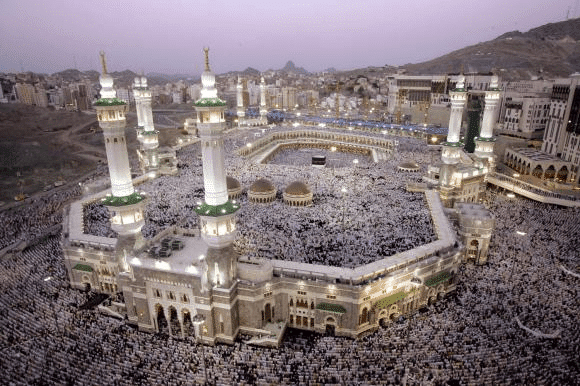
Masjid al-Haram
The Masjid al-Haram is the most important mosque in the city of Mecca and the first holy site of Islam. At the centre of the mosque is the Ka’ba, the site of the black stone that Muslims long to touch during the pilgrimage. This mosque is considered to be the largest mosque in the world.
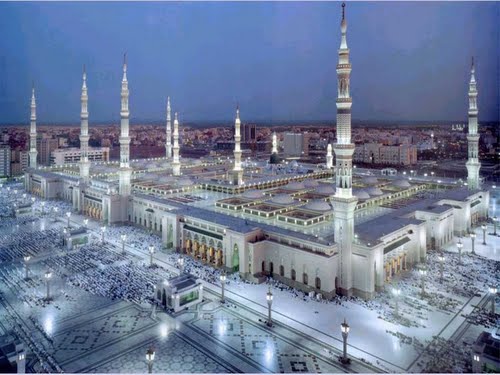
Masjid al-Nabawi
Medina, the house where Muhammad lived, is a place dear to the hearts of Muslims, where the Prophet was welcomed when he fled Mecca, gave refuge and accepted his message. It is the second holiest mosque after Mecca and before Al-Aqsa Mosque.
This mosque was built by Muhammad, and later caliphs greatly enlarged it and changed its decoration. The Prophet Muhammad is buried in this mosque.
Al-Aqsa Mosque
Located in Jerusalem, this is the place where the Prophet ascended to heaven. There he was introduced to the Prophets and met Moses, Abraham and Jesus. Its English translation would be something like “the far mosque”, the place referred to in the chapter of the Qur’an called “The Night Journey”, which says that Muhammad travels from Mecca to the farthest mosque.
According to Muslim tradition, the Prophet Muhammad ascended to heaven from this mosque, which is why it is considered the third most important place for Muslims. It is the largest mosque in Jerusalem, with a capacity of more than 5,000 people in and around it.
In the past, when the Crusader Kingdom of Jerusalem was in power, it was used as a palace and was called Solomon’s Temple because of the Temple that once stood there. It is said to have been built on the ruins of that temple, and is also said to have been rebuilt at least five times because of successive earthquakes.
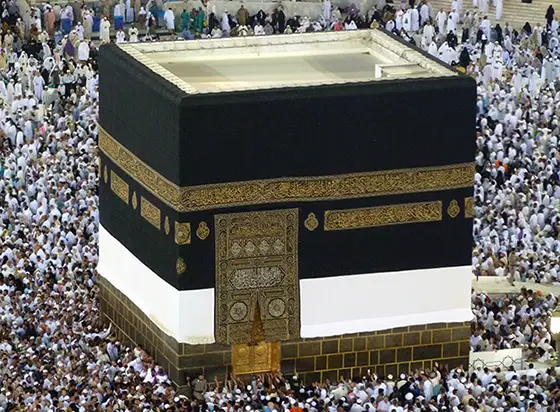
Kaaba
It translates as ‘the cube’ or ‘the die’. Located inside the Masjid al-Haram mosque in Mecca, it is the most important holy site in Islam. It is the house of God to which Muslims around the world direct their prayers, pointing to the East.
According to the Qur’an, it was built by Abraham and his son Ishmael. In one of its corners is a meteorite of unknown and undetermined origin, a black stone. It is one of the five pillars of Islam, so the pilgrimage is essential.